A claim has been traveling fast across podcasts and clips this year: that psychic ability is written into our genes, and that the witch hunts and the Inquisition quietly culled those genes out of the population. It is a gripping story. It also has a real, published study sitting underneath it. The two are not the same thing, and telling them apart is the whole point of this piece.
The short version
- There is a genuine peer-reviewed pilot study on the genetics of psychic ability. It is small and its authors call it preliminary.
- It flagged differences in non-coding DNA and a long list of candidate markers, none of it yet replicated.
- The "the Inquisition bred it out of us" idea is a hypothesis offered on top of the data, not a finding that came out of it.
- Even if a predisposition exists, the STARGATE record shows the skill is trainable. You do not have to be born with it.
The claim that is going viral
The person behind the science is Dean Radin, chief scientist at the Institute of Noetic Sciences, the research center founded by Apollo 14 astronaut Edgar Mitchell. On recent shows Radin has described genetic findings that, in his framing, suggest heightened intuitive or healing ability runs in families, and that eras like the Inquisition amounted to a kind of reverse eugenics, systematically removing sensitive individuals from the breeding population over centuries.
Stated that way, it lands hard. It offers a tidy explanation for why genuine ability seems rare today, and it flatters the idea that the trait is special, hunted, and hidden in a lucky few. That is exactly the kind of claim worth slowing down on, because the more satisfying a story feels, the less scrutiny it tends to get.
What the study actually did
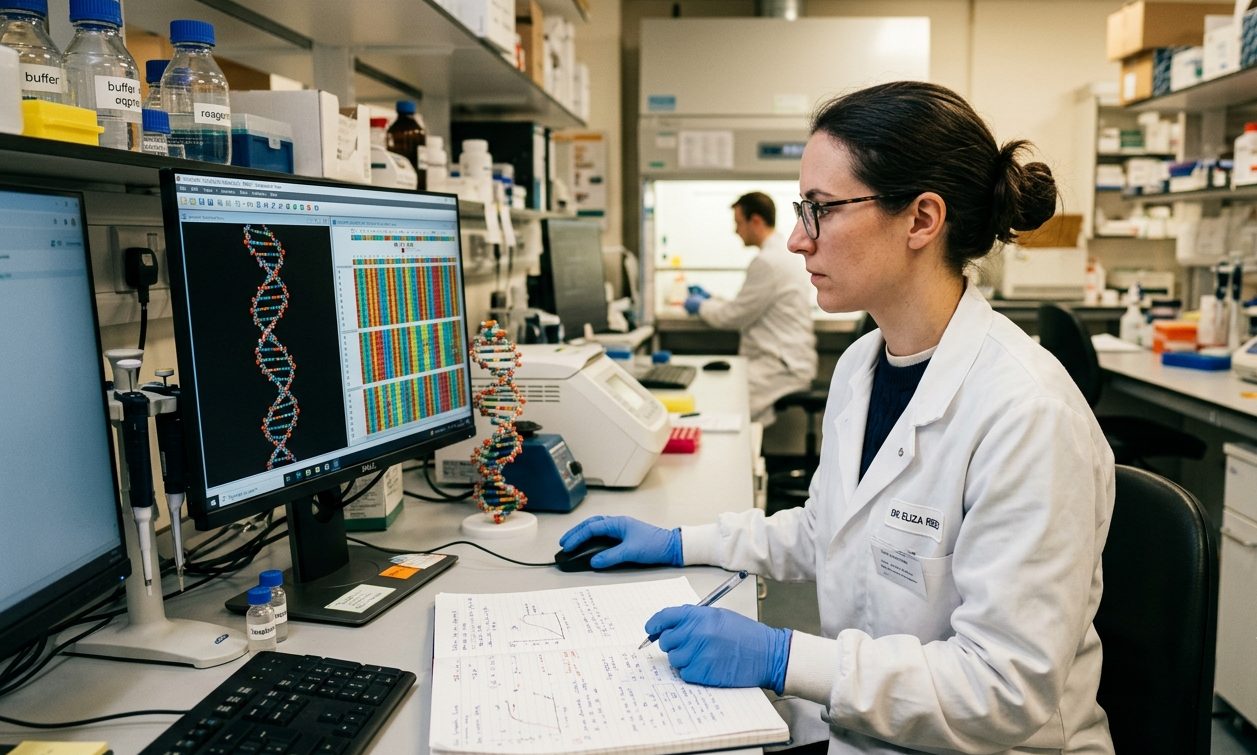
The underlying research is a case-control exome sequencing project by Radin with geneticist Garret Yount and Stanford immunologist Garry Nolan, supported by the Bial Foundation. In plain terms, the team read the protein-coding portions of the genome for a group of people identified as having strong psychic ability and compared them against a control group.
The coding regions, the stretches that tell cells which proteins to build, showed no major differences. The signal, such as it was, turned up in non-coding DNA, the parts once dismissed as junk. The team reported a difference in a small non-coding region near a gene called TNRC18, and more broadly flagged 212 single-nucleotide markers associated with reported psychic experience, one of them reaching a striking one-in-a-million statistical value.
A one-in-a-million p-value sounds decisive until you remember it was drawn from a sample you could seat around a single dinner table.
Why serious readers should slow down
This is where the credible version of the story parts ways with the viral one. The study is a pilot, and it carries every limitation a pilot carries, several of which the authors state plainly themselves.
What the study can claim
Using real sequencing methods, it found measurable differences between its psychic and control groups, concentrated in non-coding DNA, and produced a set of candidate markers worth testing again in a larger sample.
The skeptic's read
The case group was roughly a dozen people. "Psychic ability" was loosely defined. With hundreds of markers examined, some will look significant by chance. The authors concede the result could be noise, and mainstream geneticists remain unconvinced psi exists at all.
None of that makes the work worthless. Pilots exist to justify bigger studies, and this one honestly frames itself as a first pass. But a first pass on thirteen people is a hypothesis generator, not a discovery. The correct posture is curiosity held at arm's length: interesting enough to fund a replication, nowhere near strong enough to build an identity around.
The Inquisition hypothesis, weighed honestly
The reverse-eugenics idea is the most shareable part of the whole story, and it is also the part furthest from the data. There is no genetic time series here, no ancestral DNA sampled across the centuries of the witch hunts, no measured decline in any marker over generations. The claim is a narrative laid over a modern snapshot, and it is close to unfalsifiable as stated. History records that accused witches were overwhelmingly ordinary people caught in social panics, not a hidden caste of the genuinely gifted, which cuts against the premise before genetics even enters.
That does not mean the thought is worthless as a question. Traits under strong social selection can shift in a population. But a question is not a result, and presenting it as though the sequencing proved it is precisely the move that keeps this field from being taken seriously. We would rather be the site that names the difference.
What this means if you actually want the ability
Here is the part the genetics debate tends to bury. Whether or not a predisposition exists, it is not the thing that determines whether you can do this. The most robust body of evidence in this field is not about who was born with an advantage. It is about training.
The Stanford Research Institute and the STARGATE program spent two decades demonstrating that controlled remote viewing works as a structured protocol taught to ordinary recruits, not as a gift confined to naturals. Viewers improved with feedback. Scores rose with practice. The discipline was the variable that mattered. A gene study, even a strong one, would only tell you where a person starts, not where deliberate training can take them.

You do not have to be born with it. You can train it.
Psionic Training teaches the same controlled remote viewing protocol developed in the STARGATE program: real targets, scored sessions, and feedback that turns raw impressions into a measurable skill. Free to start.
Begin Training →Intel Briefings
Declassified research and honest analysis of the consciousness frontier. No spam, no woo.