The most consequential UAP document of July 2026 is not a Pentagon release. It is a chemistry preprint.
On July 6, Harvard astrophysicist Avi Loeb published a detailed summary of a paper he had received from John Birks, Professor Emeritus of Chemistry at the University of Colorado Boulder. The paper, submitted to the journal Atmospheric Chemistry and Physics, proposes that the luminous orbs reported in thousands of UAP sightings are a previously unrecognized atmospheric phenomenon: clouds of magnetized meteor dust, held together by their own remnant magnetism, heated by slow oxidation, and lit by electrical discharge.
That sentence contains a lot of physics, and this article will unpack it. But the reason the paper matters has less to do with its mechanism than with its structure. It makes a specific claim, from a named and credentialed author, grounded in a statistical correlation that anyone can check, with a mechanism that can be modeled and, in principle, reproduced in a laboratory. It can be wrong. That is what makes it worth taking seriously.
The hypothesis now has a formal audience. Loeb chairs the UAP Science Advisory Council, the body formed in June 2026 to guide government UAP investigations, and he has stated that the council will compare the model against the quantitative orb data held by the Pentagon's All-domain Anomaly Resolution Office in the coming weeks. A civilian preprint is about to be tested against classified-era sensor data. Whatever the outcome, that process is new.
The Author Is Not Who You Would Expect
Orb explanations are usually offered by anonymous commenters or professional debunkers. Birks is neither. He is an atmospheric chemist whose career includes co-developing, with Paul Crutzen in 1982, the work that became known as the nuclear winter theory. Crutzen later won the 1995 Nobel Prize in Chemistry for his research on the ozone layer. Birks went on to found 2B Technologies, a company that builds air pollution monitoring instruments, and spent decades on laboratory and field measurement of atmospheric chemistry.
In his letter to Loeb, Birks described the paper plainly: he reviewed hundreds of orb sightings reported to the National UFO Reporting Center, found that they correlate strongly with meteor fireball reports, and built a theory of orbs from the known properties of meteor dust. He believes the model can explain a large fraction of orb sightings, including daytime objects that appear solid.
None of that makes him right. Credentials do not settle empirical questions. What his background does establish is that the hypothesis comes from someone who understands atmospheric particulates professionally, and who chose to route the idea through a peer-reviewed journal rather than a podcast.
The Correlation: 508 Reports Against a Meteor Database
The empirical starting point of the paper is simple. Birks analyzed 508 orb sightings from the NUFORC database, reports describing silent luminous spheres, often colored, sometimes persisting for minutes to hours. He then compared their timing against fireball reports logged by the American Meteor Society, the volunteer network that has tracked bright meteors for over a century. The correlation between the two datasets exceeded the 99 percent confidence level.
If the association is real, it points somewhere specific. Meteors that burn up in the atmosphere do not vanish. They deposit tons of fine metallic dust, rich in iron, nickel, and magnetite, into the upper atmosphere every day. Birks proposes that under the right conditions this dust does something no one had modeled before: it organizes.
The proposed mechanism runs as follows. Meteoritic iron and nickel particles retain remnant magnetization, and that magnetism causes the dust to aggregate and hold together as a confined cloud rather than dispersing. Slow oxidation of the metallic iron, essentially rusting in mid-air, releases heat, which keeps the cloud buoyant. Collisions between particles and convective mixing build up electric charge, and when the charge crosses the breakdown threshold, the cloud discharges and emits light. The result, on paper, is a meter-scale, self-organizing, luminous object that can float, drift, glow in varying colors, and persist far longer than any flare or meteor.
The model's reach is what makes it interesting. Blinking and flickering fall out of the discharge threshold: modest changes in pressure, humidity, or local field strength switch the light on and off. Orbs that split into fragments of different colors are explained by phase separation during division, with each fragment carrying a different particle mix. Dark orbs that light up when an active orb approaches are explained by charge induction. Even the daytime cases are covered: at the particle densities involved, the cloud would be opaque, and in sunlight it would look like a solid white, gray, or silvery object. Depending on wind shear and internal convection, its shape could be spherical, disc-like, or elongated. A dust cloud that looks like a metallic disc in daylight is a bold and uncomfortable prediction, and the paper makes it on purpose.
Signal Versus Interpretation
The discipline on display here, separating what was observed from what it means, is the same discipline at the core of controlled remote viewing. CRV protocol exists to keep raw perception apart from analytical overlay. Psionic Training teaches that protocol.
Start Training →Science Has Been Here Before
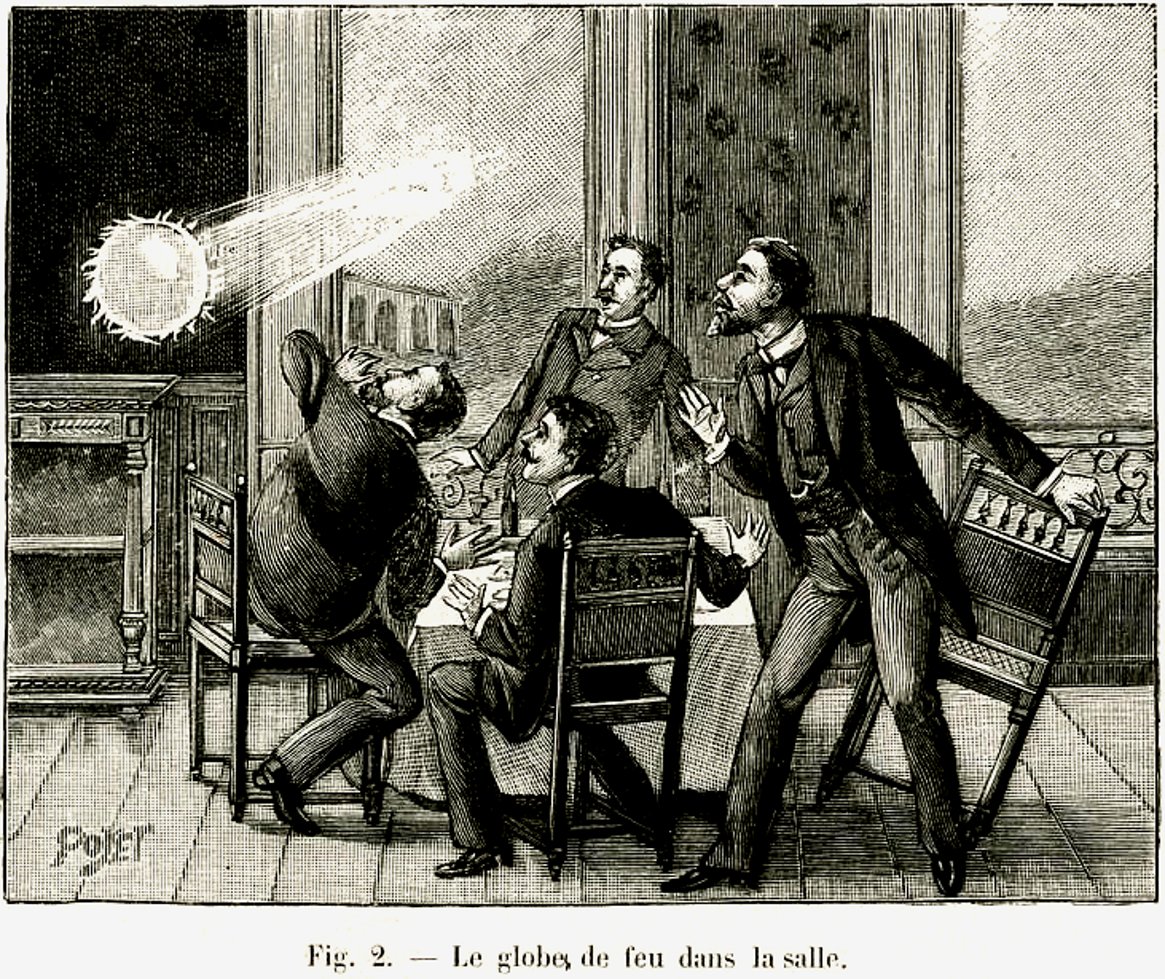
There is precedent for a luminous atmospheric anomaly spending generations in the ridicule bin before physics caught up. Ball lightning was reported for centuries: glowing spheres drifting through rooms, passing along wires, lingering for seconds to minutes. The reports came from farmers, sailors, and physicists alike, and the phenomenon was widely dismissed as misperception because no mechanism existed and no instrument had captured it.
That changed by accident in 2012, when Chinese researchers recording a thunderstorm with spectrographic equipment caught a ball lightning event forming after a cloud-to-ground strike. The spectrum, published in 2014, showed silicon, iron, and calcium, the elements of vaporized soil, consistent with a hypothesis proposed years earlier that ball lightning is a slowly oxidizing cloud of silicon nanoparticles ejected from the strike point. One good measurement moved the phenomenon from anecdote to atmospheric physics.
The parallel to the Birks model is close to exact, and it cuts in both directions. It shows that dismissing persistent witness reports because they lack a mechanism is a mistake; the witnesses were right about ball lightning for three hundred years before the instruments were. It also shows what resolution looks like: not a debate, but a spectrum. If UAP orbs are oxidizing metal dust, they will have a signature, and sooner or later an instrumented sighting will record it or fail to.
The Test: AARO's Orbs and the Western United States Event
What separates this hypothesis from a hundred prior orb theories is that it arrived at the exact moment a formal test became possible.
The Pentagon's PURSUE declassification program has put primary orb material into the public record, most notably the AARO unresolved case analysis of the Western United States Event, the October 2023 incident in which six federal law enforcement agents, working in teams over two days near a sensitive national security site, reported an orange orb that would appear for one to two seconds, release a cluster of smaller red orbs, and vanish. AARO director Jon Kosloski signed the analysis, which states that roughly 40 percent of the reported phenomena remain unresolved after review against known military and civilian systems, including flares, whose burn times and descent rates did not match. This journal examined that document in detail in a previous analysis.
Loeb has posed the question directly: could the AARO orbs be meteoritic dust clouds? The orange parent orb releasing red fragments reads differently under the Birks model than it does under a craft interpretation. Orb division with color change is one of the model's predicted behaviors, the result of phase separation as a magnetically bound cloud splits under mechanical stress. Long duration, silence, and intermittent appearance are all native to the mechanism. The UAP Science Advisory Council, which Loeb chairs, has said it will run the comparison against AARO's quantitative data in the coming weeks.
The council's framing deserves attention, because it is methodologically honest. Loeb has been explicit that the analysis succeeds if it explains away some cases and thereby focuses attention on the ones it cannot explain. UAP are a mixed bag, in his words. The dusty plasma model is not being offered as a theory of everything. It is being offered as a filter.
There is also a laboratory path. The paper suggests the phenomenon might be reproducible from magnetic iron nanoparticles under controlled conditions. A hypothesis about rare atmospheric events that can be dragged onto a bench is rare in this field. If someone generates a persistent luminous plasmoid from magnetized iron dust, the argument changes overnight. Birks also notes a modern complication: with roughly 11,000 active communication satellites in orbit, most of them in low orbits with five-year lifespans, reentering spacecraft debris is now seeding the atmosphere with metallic dust of its own. If the model is right, human activity may be manufacturing orbs.
The Skeptic's Read of the Skeptical Hypothesis
A mundane explanation still has to earn its evidence, and this one has real weaknesses worth stating plainly.
The preprint has not passed peer review. Atmospheric Chemistry and Physics uses open review, so the referee reports will eventually be public, and until then the paper's statistics and energetics are unverified claims. The input data is also soft. NUFORC reports are unvetted public submissions with known biases: media attention drives reporting waves, and clear moonless nights produce both more fireball reports and more orb reports. A correlation between the two databases could reflect a shared cause, more people looking at better skies, rather than a physical link between meteors and orbs. The paper's statistical case will need to survive that objection in review.
The mechanism itself asks a lot of dust. Self-organizing, magnetically confined, hours-long luminous plasmoids at meter scale are not an observed laboratory phenomenon; they are an extrapolation from known material properties. The energetics may work on paper and still describe something the atmosphere never actually builds. That is precisely what the proposed lab work would settle, and until it does, the model sits in the same category ball lightning theories occupied before 2014: plausible, unconfirmed.
And the model's scope is bounded. It addresses orbs: silent, luminous, drifting phenomena. It does not address the radar-visual military cases involving structured objects with sustained controlled flight, instrument tracking across multiple sensor types, and transmedium behavior. Nothing in a buoyant dust cloud accounts for an object holding formation against wind or accelerating out of a sensor gate. Anyone extending the dusty plasma model to those cases is stretching it past what its own author claims for it.
What Would Count as an Answer
Three things are worth watching over the next several months. The first is the UAP Science Advisory Council's comparison of the model against AARO's orb data, including the Western United States Event. If the model quantitatively matches the reported durations, colors, and division behavior, some of the government's unresolved cases will move to resolved, and the remainder will become sharper. The second is the fate of the preprint in open peer review, where the correlation methodology will face its first hostile audience. The third is the laboratory question: whether anyone can make one.
Each outcome is informative. A confirmed model would explain a real fraction of UAP reports with new atmospheric physics, which would itself be a discovery. A failed model, tested honestly, would strengthen the residue of cases that resist mundane explanation, which is what makes those cases worth studying. The only unproductive outcome is the one this field has defaulted to for decades: no test at all.
For readers of this journal, the deeper lesson is methodological. The entire dispute turns on the discipline of separating raw observation from interpretation. Witnesses reported orange and red lights, durations, and splitting behavior; the word orb, let alone craft, is already a layer of analysis on top of that signal. The government's own STARGATE program institutionalized exactly this separation in a different domain, training viewers to record perception before meaning and flag conclusions as overlay. Whether the subject is a light in the sky or a signal in the mind, the failure mode is identical: deciding what something is before finishing the description of what it does. The dusty plasma hypothesis, whatever becomes of it, is what finishing the description looks like.
Share this analysis

The protocols exist. They are trainable.
The same government now testing physical hypotheses for UAP spent two decades training remote viewers under Project STARGATE. The protocols developed from that research are documented, peer-reviewed, and available. Psionic Training is built on them.
Begin Training →Research Alerts
Get our analysis when the council publishes its orb findings, plus every new PURSUE release. No noise.