The Pentagon's All-domain Anomaly Resolution Office released its Fiscal Year 2025 Consolidated Annual Report on Unidentified Anomalous Phenomena in late July, months after the annual cycle Congress set out in the office's authorizing statute. The document is fourteen pages long. It contains no revelations, no recovered craft, and no confirmation of anything exotic. What it contains instead is numbers, and the numbers are the most useful thing published on UAP this year.
The report covers everything that entered AARO's caseload between June 2, 2024 and May 30, 2025. Read carefully, it answers three questions that tend to get lost in the disclosure noise: how much of the UAP problem dissolves when someone with the right tools looks at it, what kind of residue is left over when they do, and where the actual gaps in the government's ability to answer the question sit. This article walks through all three, using the report's own figures throughout.
The Headline Numbers
As of May 30, 2025, AARO's total case holdings stood at 1,870 reports. During the reporting year the office received 319 new UAP reports. Of those, 284 described events that happened during the reporting period, and 35 described older events, from 2010 through 2024, that had never been captured in a previous annual report.
The intake broke down almost entirely into one domain. AARO assessed 274 of the 319 reports as air-domain events, 44 as space-domain, and exactly one as maritime. That single maritime case is the report from U.S. Navy assets off the coast of Virginia describing approximately 100 airborne UAP and two likely uncrewed surface vessels, which AARO says it is actively investigating with the reporting unit. It is the strangest item in the document, and we have analyzed it separately; here it matters as one data point in a much larger picture.
On the resolution side, AARO closed 114 of the 319 new reports. It also resolved 256 cases from earlier reporting periods, for a total of 370 resolutions in a single year. That closure rate against the backlog is the quiet story of this report. For comparison, the FY2024 report logged 757 incoming reports, a figure inflated by a large batch of backlogged FAA submissions dating back to 2021. The FY2025 intake is smaller and cleaner, and the office is now closing old cases faster than new ones arrive.
What Actually Got Solved
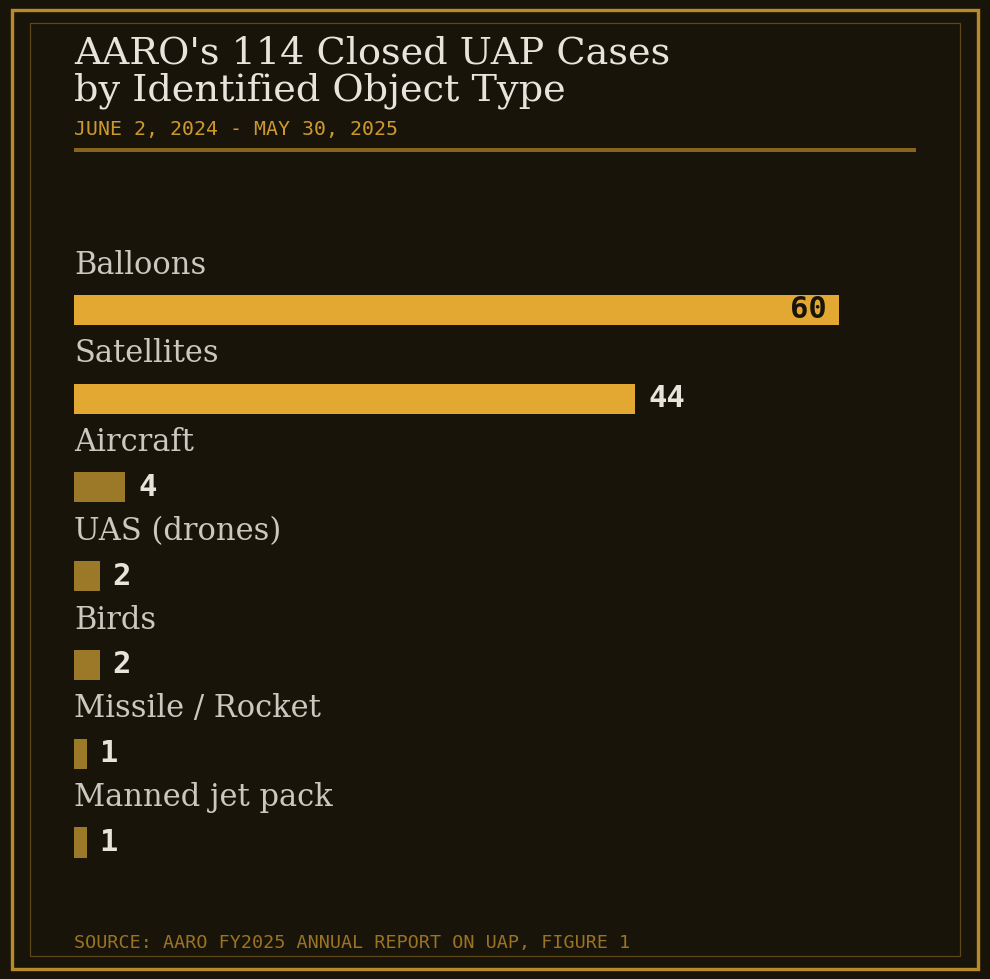
The report includes a chart of the 114 in-period resolutions by object type, and it reads like an inventory of the ordinary sky. Sixty cases resolved as balloons, everything from foil party balloons to large tethered research platforms. Forty-four resolved as satellites. Four were aircraft. Two were unmanned aerial systems, two were birds, one was a commercial rocket launch, and one was a manned jet pack.
That last item has gotten the internet's attention for understandable reasons, but the serious takeaway is the shape of the distribution. Balloons and satellites alone account for 104 of 114 closures, about 91 percent. Nothing in the resolved set required a novel explanation. AARO states directly that none of the cases it has resolved indicate advanced foreign adversarial capabilities or breakthrough technologies in any domain.
The report is equally direct about what resolution requires: data. Every closed case had enough sensor evidence, imagery, or narrative detail to support what the office calls a high-confidence assessment. The cases that stay open are not the ones with the most dramatic descriptions. They are the ones with the least usable data.
What People Reported Seeing
The report's morphology data is consistent with the historical pattern, which is itself informative. Where reporters described distinct visual characteristics, spheroidal objects accounted for 40 percent of descriptions and lights for 33 percent. The orb, in other words, remains the dominant modern UAP. The "other" category preserves the stranger entries in the government's own words: a cross shape, a star shape, an elongated diamond described as two inverted pyramids, and a flaming object that fell from the sky. Meanwhile 77 of the 319 reports, about 24 percent, contained too little information to characterize the object's shape at all.
Altitude reporting clustered between 10,000 and 35,000 feet, which is where aircraft fly and where pilots, the system's most prolific reporters, spend their time looking. AARO is explicit that its caseload carries a collection bias toward the continental United States and areas dense with U.S. military sensors. The map of UAP reports is substantially a map of who is watching. The office also recorded no reports of flight safety concerns and, through the May 2025 cutoff, no reports of adverse health effects associated with a UAP encounter, a quiet counterpoint to years of claims on that subject.
The Satellite Problem Nobody Had Modeled
The single most consequential item in the report is a tool. During the reporting period AARO onboarded a new analytic capability built on three-dimensional modeling and simulation, designed to test whether a reported sighting lines up with sunlight reflecting off a satellite. The office says this capability enabled analysts to resolve 238 reported UAP as satellite flaring, a figure that spans both the in-period caseload and the older backlog it closed this year.
Flaring is not a new phenomenon. Reflected sunlight from satellite surfaces becomes visible at specific viewing angles, and can appear as an intense bright orb, many times brighter than the surrounding stars, persisting anywhere from a fraction of a second to several minutes. What is new is the scale of the satellite population and the ability to check any given sighting against it. Every one of AARO's 44 space-domain cases this year, none of which came from space-based sensors, resolved as satellite flaring. Forty-two of them originated as civilian pilot reports filed through the FAA, which now supplies 21 percent of AARO's total incoming reporting.
The altitude data tells the same story from another angle. Reports of UAP above 45,000 feet fell from 27 percent of the caseload in FY2024 to 4 percent this year. AARO attributes the drop partly to a collection bias in the previous year's FAA batch, but also notes that many of those high-altitude pilot reports, typically describing bright objects estimated at 45,000 to 60,000 feet, resolved as satellite flares once the modeling was applied. A category of sighting that looked like a genuine pattern two years ago is evaporating under a better instrument.
For anyone who followed our earlier analysis of AARO's unresolved Western United States orb case, this is the essential context. The sky in 2026 is full of reflective hardware. Any orb report that does not rule out satellite flaring has not yet cleared the first bar.
The Residue: What Stayed Open
Here is the part of the report that both the believer and debunker framings tend to misread. Of the 319 new reports, 114 were resolved, and three more are pending closure as preliminary satellite-flare assessments awaiting director authorization. The office transferred 191 cases to what it calls the active archive. Nine reports were identified as meriting further analysis by intelligence community and science and technology partners with relevant technical expertise.
The active archive is not a euphemism for mystery. The report defines it as the category for reports with insufficient data to assess whether the underlying event is consistent with natural phenomena or exceeds the known state of the art for technological systems. These cases sit in a holding pattern, informing AARO's location and trend analyses, open to future resolution if better data or better techniques arrive. Sixty percent of the year's intake landed there, unresolved not because the events defied explanation but because nobody captured enough information to attempt one. The report's most repeated complaint is exactly this: a lack of timely and actionable sensor data continues to constrain AARO's ability to resolve cases.
The nine referred cases are the interesting residue. The report says nothing about their content, only that they warrant deeper analysis by specialist partners. Alongside them sit two reports describing electronic or avionic interference attributed to UAP near operational aircraft, on which AARO has not yet rendered a determination. And in its section on restricted airspace and critical infrastructure, the report includes its most carefully worded sentence: some narrative reports were suggestive of phenomena whose performance characteristics exceed the known state of the art within a given domain, with no technical data accompanying those reports. If validated, the office writes, the phenomena underlying them may represent a currently unmitigated threat vector.
That sentence is doing precise work. It is neither a confirmation nor a dismissal. It is an intelligence office saying that the most anomalous claims in its files arrived as testimony without instruments, and that testimony without instruments cannot be validated or retired. The whole UAP problem, compressed into three sentences of bureaucratic prose.
The Drone Numbers Next to the Nuclear Sites
One section of the report has nothing to do with UAP by AARO's own classification, and may still be its most operationally significant content. Through its required consultation with the Administrator for Nuclear Security and the Nuclear Regulatory Commission, AARO received 50 reports of unmanned aerial systems operating near U.S. nuclear infrastructure, weapons, and launch sites during the reporting period. The FY2024 figure was 18. That is a 177.8 percent increase in a single year.
The details read like a pattern, not an accident. Forty-seven of the 50 incidents occurred between 5:00 p.m. and 5:00 a.m. local time. Most involved a single drone, but 17 involved between two and seven. Five incidents persisted for at least an hour, the longest for roughly three. Quadcopters were the most commonly reported type. None of these incidents were reported as UAP; these are identified drones of unknown operator, which is a different and arguably more tractable security problem. But the trajectory of that number, 18 to 50 in a year, is worth tracking regardless of what one believes about anomalous phenomena.
The Whistleblower Funnel
The report also updates the mechanism Congress created for insiders to report knowledge of undisclosed government UAP programs. AARO's secure reporting channel received 262 submissions from individuals claiming firsthand knowledge. Of those, 255 were determined to be out of scope. Seven individuals were identified for follow-up interviews.
Those numbers deserve a moment of neutral attention, because both camps will spin them. A 97 percent out-of-scope rate does not mean 255 people lied; the channel's scope is narrow, covering alleged government programs rather than personal sightings, and most submissions apparently fell outside it. Equally, seven interviews does not mean seven validated whistleblowers; it means seven claims cleared the initial filter. With the July directive ordering agencies to waive nondisclosure agreements for individuals cooperating with AARO and the PURSUE task force, the FY2026 version of this funnel will be one of the more meaningful indicators in the entire disclosure effort. If the NDA barrier was real, the submission and interview numbers should move.
Reading the Report Like a Researcher
The reporting cadence itself says something. The statute behind this document requires annual delivery to the congressional intelligence and armed services committees, and previous editions arrived in the fall; the FY2024 report was published in November 2024. This one surfaced in late July 2026, roughly eight months behind that rhythm, with an information cutoff already fourteen months old. Whatever the internal reasons, the delay means the most current official UAP dataset ends in May 2025 while the PURSUE releases pour historical files into public view on a monthly cycle. Official analysis is now lagging official disclosure, which is a strange inversion.
On the substance, the honest summary runs like this. The FY2025 report shows an office that has gotten measurably better at explaining sightings, and the things it explains are mundane: balloons, satellites, birds, one man on a jet pack. The satellite-flare tool alone accounts for 238 resolutions, and its success against the FAA pilot reports suggests a large fraction of the modern orb phenomenon is reflected sunlight on orbital hardware. Anyone whose interest in UAP depends on those cases should update accordingly.
At the same time, the report does not close the file. Nine cases were escalated to specialist analysis. Two interference reports remain undetermined. A hundred objects off Virginia are under active investigation. And the office itself concedes that the reports describing genuinely anomalous performance are exactly the ones that arrive without data. The residue is small, but it is the government's own residue, published under its own letterhead.
That pattern will be familiar to anyone who has studied the STARGATE program record: a large volume of noise, honest filtering that eliminates most of it, and a stubborn remainder that survives the filter without quite proving anything. The discipline is in refusing to round the remainder in either direction. AARO's FY2025 report, whatever its delays, mostly manages that discipline. The primary document is fourteen pages and freely available. It rewards a direct reading far more than the coverage of it does.
Share this analysis

Structured protocols. Scored results.
AARO resolves cases by testing observations against models. Controlled remote viewing applies the same discipline to perception itself: structured sessions, objective targets, scored feedback. The protocols developed for the STARGATE program are documented and trainable. Psionic Training is built on them.
Begin Training →Report Analysis Alerts
Get our breakdown of every official UAP report and PURSUE release. Numbers first, no noise.