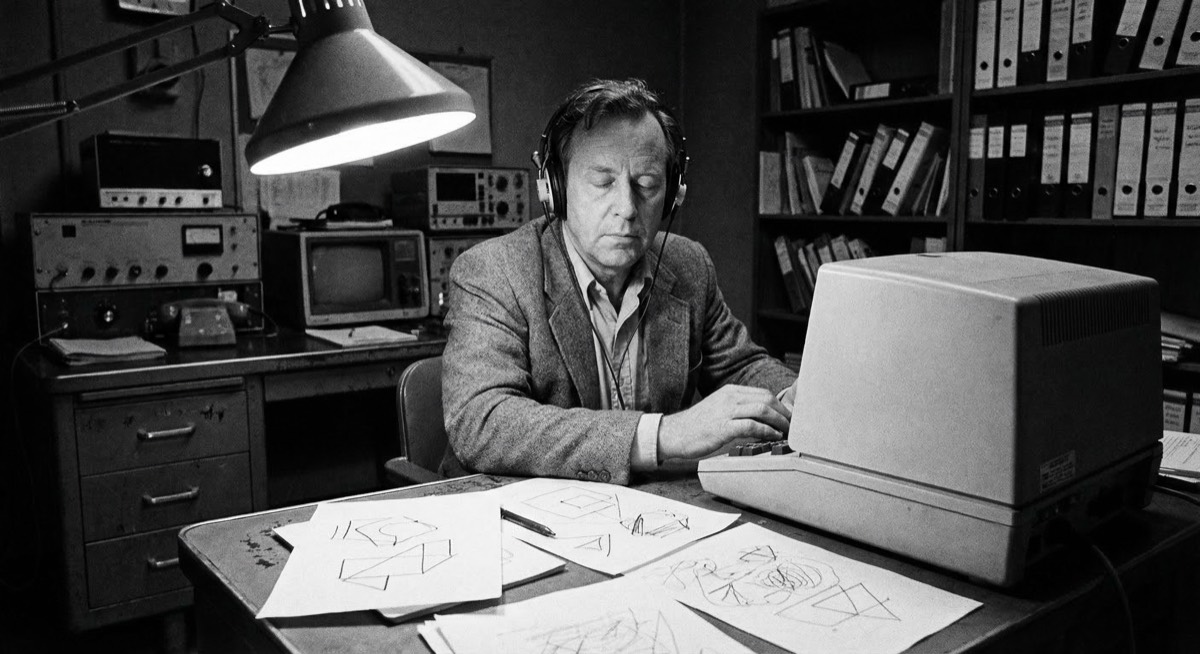
Before Ingo Swann, government-sponsored psychic research was an inconsistent, unrepeatable mess — fascinating data from gifted individuals that couldn't be systematized, trained, or reliably deployed. Swann changed that. By the time he was finished, the United States military had a structured, teachable protocol for remote perception that could turn ordinary soldiers into operational intelligence assets.
Swann (born September 14, 1933, in Telluride, Colorado; died January 31, 2013, in New York City) spent the first part of his career as a painter and sculptor in Manhattan's avant-garde art scene, where his work was exhibited alongside figures like Andy Warhol and Lee Krasner. But from early childhood, he had reported experiences that defied ordinary explanation — out-of-body perceptions, apparent knowledge of distant events, what he later called "distant sensing."
First Contact: The American Society for Psychical Research
In 1971, Swann began formal experiments at the American Society for Psychical Research (ASPR) in New York, working with parapsychologist Karlis Osis. The experiments involved Swann attempting to perceive a target placed in a sealed box above him while his brain activity was monitored. The results were sufficiently anomalous to attract wider attention.
Word reached Hal Puthoff, a laser physicist at Stanford Research Institute (SRI) in Menlo Park, California, who was quietly investigating the scientific basis for psychic phenomena under contract with the CIA. Puthoff invited Swann to SRI in 1972, and what began as a series of preliminary tests quickly escalated into one of the most significant classified research programs in American history.
Stanford Research Institute: Building the Protocol
At SRI, Swann worked alongside Puthoff and physicist Russell Targ on a series of rigorously controlled experiments. The initial protocol involved "coordinate remote viewing" — giving the subject only a pair of geographic coordinates and asking them to describe the location. No maps, no images, no context. Just numbers.
What made Swann invaluable was not merely his apparent talent, but his analytical mind and his willingness to examine his own process. He recognized early that the primary obstacle to reliable remote viewing was what he called "analytical overlay" — the tendency of the conscious mind to interpret, categorize, and confabulate on top of genuine perceptual signal. A viewer who perceived something curved and warm would instinctively jump to "sun" or "lamp" — imposing a conclusion that might obliterate more specific, accurate data lying beneath.
Swann's solution was structural: break the viewing session into discrete stages, each designed to elicit a different category of information while suppressing premature analytical interpretation. Stage I captured gross sensory impressions. Stage II developed sensory data in more detail. Stage III addressed dimensional qualities. Subsequent stages moved progressively deeper into the target — its function, emotional tone, and specific features — only after the viewer had exhausted raw perceptual data at each prior level.
Train the Protocol
Swann's protocol is now trainable at scale. Psionic Training uses AI scoring to give you the same kind of objective feedback that SRI's researchers provided to their viewers.
Start Training →CRV: The Six-Stage Protocol
By the early 1980s, Swann had formalized what he called Controlled Remote Viewing (CRV) — a six-stage protocol that could, in principle, be taught to anyone. The six stages were:
- Stage I: Gross impressions — basic gestalt of the site (land, water, structure, etc.)
- Stage II: Sensory data — colors, textures, temperatures, sounds, smells
- Stage III: Dimensional data — height, width, mass, spatial relationships
- Stage IV: Analytical data and emotional impact
- Stage V: Specific topic interrogation using advanced ideograms
- Stage VI: Three-dimensional modeling and detailed reconstruction of complex sites
Swann began teaching this protocol to military remote viewers at Fort Meade, Maryland, starting in 1983 under the program then designated GRILL FLAME. His students included Joseph McMoneagle, who would become arguably the most decorated operational remote viewer in the program's history, credited with intelligence successes against Soviet targets.
Penetration: Remote Viewing the Moon
One of the most controversial episodes in Swann's career was described in his 1998 book Penetration: The Question of Extraterrestrial and Human Telepathy. In it, Swann described being approached by an unnamed intelligence operative and asked to remote-view the far side of the Moon — not as a geographic exercise, but with the apparent expectation of finding something there.
Whether taken literally or as illustrative of the program's ambitions, Penetration illustrated the reach of what government-sponsored remote viewing had become. (For a detailed look at the most documented of Swann's off-planet sessions, see our analysis of Swann's Jupiter problem.) by the late 1970s and early 1980s: a tool that its practitioners believed capable of extending perception not merely across geographic distance, but potentially beyond the boundaries of what conventional intelligence could access.
The book remains controversial and was published outside the mainstream of Swann's scientific work. But it points to something real: by the program's peak operational years, the question was no longer whether remote viewing worked in the laboratory — it was how far it could extend.
Legacy
Ingo Swann's contributions to the STARGATE program — and to consciousness research more broadly — are difficult to overstate. He was, simultaneously, the most gifted natural remote viewer the program identified and its most rigorous methodologist. The CRV protocol he developed remains in active use by civilian training programs worldwide, taught by former military viewers who trained under him directly.
He was awarded the CIA's Intelligence Medal in 1975, though the award and its circumstances remained classified for decades. His published works — including To Kiss Earth Goodbye (1975) and Everybody's Guide to Natural ESP (1991) — brought the subject to general audiences without sacrificing the rigor that characterized his laboratory work.
When Swann died in January 2013, he left behind something genuinely rare: a systematic, repeatable, teachable method for a class of human experience that most of the scientific establishment still refuses to acknowledge exists. The declassified record of Project STARGATE suggests that the establishment may be wrong.

Train the Protocol Swann Built
Psionic Training uses the six-stage CRV methodology Ingo Swann developed at SRI — the same protocol taught to military viewers at Fort Meade. AI-scored, blind targets, rigorous methodology.
Begin Training →Further Reading
- Swann, I. (1991). Everybody's Guide to Natural ESP. Tarcher/Putnam.
- Swann, I. (1998). Penetration: The Question of Extraterrestrial and Human Telepathy. Ingo Swann Books.
- Targ, R. & Puthoff, H. (1974). "Information transmission under conditions of sensory shielding." Nature, 251, 602–607.
- Smith, P. (2005). Reading the Enemy's Mind: Inside Star Gate — America's Psychic Espionage Program. Forge Books.
- CIA CREST Database: Project STARGATE documents, declassified 1995–2017.
Intel Briefings
Stay in the signal: analysis of declassified research, remote viewing science, and new findings. No noise.