On Friday, August 7, the Department of War posted its fifth tranche of Unidentified Anomalous Phenomena files to war.gov/UFO. The release contains 41 files: documents, images, and videos drawn from the Pentagon, the FBI, the CIA, the State Department, and the Executive Office of the President. The oldest record dates to 1950. The newest were generated this year.
This is the fifth release under the executive order President Trump signed in January directing agencies to produce their UAP records, and the cadence has been steady: five tranches between May 8 and August 7. Most of the new material is familiar in kind. Grainy sensor footage, redacted reports, witness interviews. But two documents in this batch stand apart for the quality of the sourcing and the difficulty of explaining them away. One is an intelligence report describing roughly 25 objects interacting with a US Special Operations gunship over the Gulf of Oman. The other is an FBI interview record describing a 500-foot silent triangle over Bagram Air Base in 2002.
Both deserve a careful reading, which means presenting what the documents say, what the strongest mundane explanations are, and what remains open after both are weighed. That is what follows.
What Was Released and When
Release 5 follows the pattern established by the first four tranches, which this journal has covered in earlier analyses of the program's structure and the FBI's contributions. Announcing the release, Pentagon spokesman Sean Parnell described it as part of the Presidential Unsealing and Reporting System for UAP Encounters, the formal name behind the PURSUE acronym, and the department confirmed that additional files will follow on a rolling basis.
The bulk of the tranche is video. Six clips document a single 2021 encounter over the Gulf of Oman, recorded as cellphone video of sensor screens aboard an AC-130J gunship. Another clip, submitted by US Central Command, shows an object crossing the frame of a military aircraft's camera over a populated area in the Middle East in 2025. That case, like the gunship encounter, remains unresolved. The release also includes eight FBI witness-interview records, known as 302 forms, most paired with digital renderings the bureau produced from witness descriptions, and several accompanied by video the witnesses themselves recorded.
Redactions run throughout. The department states that dates, locations, and names are withheld to protect witness identities and information about government facilities, including military sites unrelated to UAP. That is standard practice, and it is also the single largest obstacle to independent verification. A researcher cannot cross-check a sighting against weather records, flight logs, or satellite passes when the date and location are blacked out. The tension between witness protection and verifiability runs through the entire PURSUE program, and Release 5 does not resolve it.
The Gulf of Oman Gunship Encounter
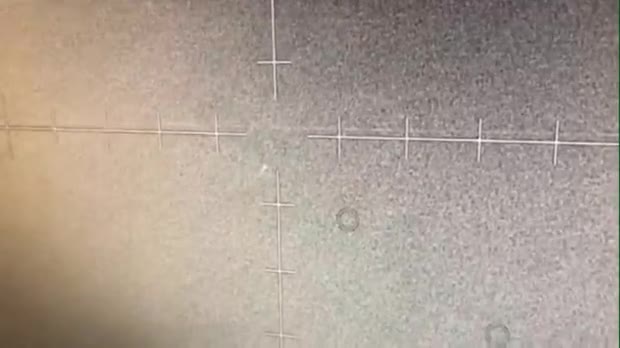
The strongest document in Release 5 is an intelligence information report, catalogued as DOW-UAP-D101, describing an encounter in September 2021. Special Operations forces aboard an AC-130J gunship were conducting a live-fire exercise over the Gulf of Oman when, in the report's words, they "observed approximately 25 instances of UAPs."
The report's description is specific. "The UAPs were observed as cold orbs flying at lower altitudes between 250 to 1300 MPH in different formations as well as maneuvering aggressively. UAPs also appeared to react to the aircraft firing its main cannon."
Three details matter here. First, "cold" is a sensor characterization, meaning the objects showed no significant heat signature on infrared. Whatever they were, they were not displaying the exhaust plume of a conventional propulsion system. Second, the speed range attributed to them, 250 to 1,300 miles per hour, spans everything from a light aircraft to well past the speed of sound, at low altitude, with no reported sonic signatures. Third, and most unusual for an official report, is the claim of apparent responsiveness. Objects that "appeared to react" to cannon fire implies behavior, not just presence.
The All-domain Anomaly Resolution Office, the Pentagon's UAP investigative arm, reviewed the case and could not resolve it. That designation should be read precisely. Unresolved means AARO could not match the data to a known object or phenomenon with the information available. It is not a finding that the objects were anomalous. AARO has resolved the majority of cases it has examined into balloons, drones, birds, and sensor artifacts, which makes the cases it cannot resolve, particularly those with trained military observers and multiple sensor recordings, the interesting residue.
An AC-130J crew is about as good as military witnesses get. These are sensor operators whose job is identifying and tracking objects near their aircraft, working multiple instruments simultaneously during a live-fire evolution. The encounter produced six separate recordings. Whatever weight one assigns the interpretation, the observational record is unusually thick.
The Bagram Triangle
The document drawing the most public attention is an FBI FD-302, catalogued as FBI-UAP-D024, recording a 2024 interview with a former military pilot. A 302 is the bureau's standard form for memorializing witness interviews. It documents what a witness said, filtered through an agent's contemporaneous notes. It is testimony, not sensor data.
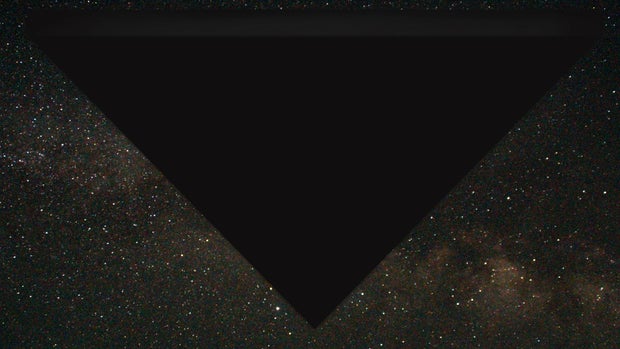
The pilot's account concerns something he saw at Bagram Air Base, Afghanistan, in 2002. At approximately 4:30 in the morning local time, he noticed that the stars over the base were being blacked out. In the agent's words, "It appeared as if something huge went overhead, from west to east, and was an equilateral triangle shape. The object was moving silently, at a consistent speed and altitude, possibly 150 knots, with no lights visible."
The pilot estimated the object at 500 feet across, while acknowledging he could not fully see its shape. He was not alone. The report states that the pilot standing with him also observed the triangle, and as it passed overhead asked, "did you see that?" The FBI produced a digital rendering from his description, the image at the top of this article: a black wedge defined only by the stars it obscures.
The profile is worth stating plainly, because it does not match any aircraft publicly known to have operated over Afghanistan in 2002. A 500-foot equilateral triangle would be more than twice the wingspan of a B-52. Moving at roughly 150 knots, silent, with no lighting, over an active military airfield in a war zone, it would represent either a massive intelligence failure, an unacknowledged platform of extraordinary scale, or a misperception. There is no fourth option that survives contact with the details as reported.
Trained Observation Is a Skill
Every document in PURSUE ultimately rests on the quality of human observation and reporting. The structured perception protocols developed at SRI and Fort Meade were built to discipline exactly that. Psionic Training teaches them.
Start Training →The Same Pilot, Twenty-One Years Later
The 302 contains a second thread that has received less attention. The same pilot told the interviewing agent that in October 2023, on a flight from Massachusetts to Ireland at 37,000 feet, he observed white lights he judged to be above him, probably at 50,000 feet or higher. "The lights were white in color, would start out as dim, and get brighter before they eventually faded out," the report records. "The full cycle of the lights would range from 10 seconds to one minute." He reported seeing the same lights roughly ten times on subsequent flights, and said other pilots had been reporting strange lights in the same window, between midnight and 3 a.m.
This pattern, high-altitude lights that brighten and fade on a cycle, has a candidate explanation that the 2002 account does not: satellite flares. Sunlight glinting off satellites, including the flat panels of large constellations, produces exactly this signature for observers in darkness below, and reports of such lights from transatlantic flight crews have grown with the satellite population. The report does not evaluate this possibility. It simply records the testimony. But the contrast between the two accounts is instructive. One has a ready astronautical explanation. The other, a star-occluding triangle at low altitude, does not.
The FBI's 2026 Casework
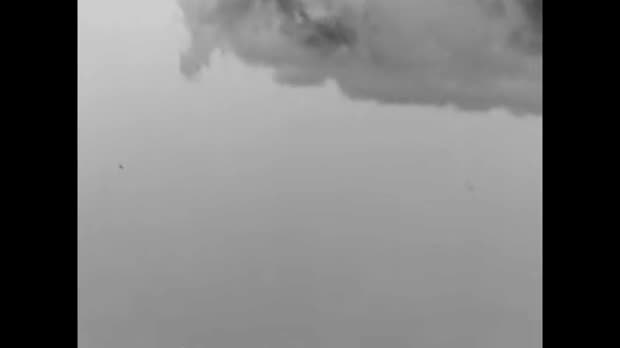
Beyond the historical cases, Release 5 documents something structurally new: federal agents working UAP reports in real time, this year. One partially redacted report, FBI-UAP-D032, describes a US government special agent who responded to a report of an unusual radio frequency detection, pointed a handheld infrared sensor toward it, and observed a dark object in the sky. A second object appeared beside the first. "Both were black hot," the report states, meaning they registered as colder than the surrounding sky on thermal imaging. The agent photographed and filmed the pair for five to ten minutes before they moved out of view. The accompanying footage shows two slow-moving black-hot contrasts crossing the frame.
Other 2026 records include a civilian who reported three separate sightings within a five-hour window in the western United States, a second witness who corroborated similar incidents by phone, and an agent who observed what a report calls a "thermally elevated aerial object" while conducting surveillance. The bureau produced digital renderings from several of these interviews, including a night scene of red lights over a mountain range that witnesses described syncing up and moving together toward the east-southeast.
Renderings are illustrations of testimony. They add no evidentiary weight beyond the words in the 302s, and it is fair to note that a professionally produced image can make a verbal account feel more real than it is. What the renderings do demonstrate is process. The FBI is interviewing witnesses, commissioning visual reconstructions, and routing the results into a declassification pipeline within months of the events. That is a different institutional posture than the decades-long lag that characterized the STARGATE-era records this journal usually works with.
The Skeptic's Read
The mundane case against the Bagram triangle is straightforward and strong. The account was given in 2024, describing an event from 2002. Twenty-two years is a long time, and memory research is unambiguous that recollections of brief, ambiguous, emotionally striking events drift and consolidate over decades. The corroborating witness appears in the record only through the primary witness's own recollection of his remark. There is no radar track, no imagery, no contemporaneous log entry in the released file. And night-time size estimation without reference points is notoriously unreliable: a small dark object at low altitude and a huge one at high altitude produce the same retinal image. A flight of birds occluding stars, a blimp-like platform, or a formation of aircraft with lights off have all been proposed for triangle reports of this type generally.
The gunship case invites a different critique. Infrared sensor footage of small returns is exactly the class of data that has repeatedly fooled analysts. Range ambiguity means an object's apparent speed on a tracking sensor can be wildly wrong, as the Navy's GoFast video demonstrated when trigonometry showed a slow-moving object rather than a fast one. Cold orbs at low altitude over water could be balloons, birds, or debris, with the speed range an artifact of bad range assumptions. Apparent reaction to cannon fire could be coincidence compressed into a narrative by crews primed to see interaction. AARO's inability to resolve the case may reflect nothing more than insufficient data.
All of that is fair, and none of it should be waved away. But the skeptical read carries costs of its own. To dismiss the gunship report entirely, one has to set aside approximately 25 sequential observations by multiple trained sensor operators across multiple instruments during a single sortie, made by a crew whose survival depends on correctly classifying objects around their aircraft. To dismiss Bagram, one has to conclude that two military pilots simultaneously misperceived the same absence of stars, and that the second pilot's reaction in the moment was to a shared illusion. Both are possible. Neither is free, and choosing between the mundane and anomalous readings on current evidence says more about the reader's priors than about the documents.
What Remains Open
The honest summary of Release 5 is that it adds two well-documented unresolved cases to the public record and a procedural window into active federal UAP casework, while resolving nothing. The documents do not establish the existence of exotic craft, and this journal will not claim otherwise. What they establish is narrower and still significant: the US government's own analytic machinery, applying current methods, cannot account for a subset of encounters reported by its most qualified observers, and it has chosen to publish that fact under agency letterhead.
Things worth tracking from here. Whether future tranches include the radar or datalink records that should exist for the Gulf of Oman encounter, since an AC-130J does not operate in a sensor vacuum. Whether any contemporaneous 2002 record from Bagram surfaces to anchor the triangle account. And whether the FBI's 2026 casework continues to appear in near-real time, which would make PURSUE something no previous declassification effort has been: a live feed rather than an archive.
The through-line for readers of this journal is the one that runs back to Project STARGATE. The government has always treated anomalous phenomena as a data problem entangled with a human-perception problem. Release 5 is that entanglement in miniature: sensor records that cannot be resolved, and human testimony that cannot be verified, published side by side and left open. Reading the documents themselves, rather than the headlines about them, remains the only defensible method.
Share this analysis

The protocols exist. They are trainable.
The same government that published these files spent two decades training remote viewers under Project STARGATE. Those protocols are documented, peer-reviewed, and available. Psionic Training is built on them.
Begin Training →PURSUE File Alerts
Get notified when new PURSUE tranches drop, plus our analysis of each release. No noise.